You paste a page of text into Claude or ChatGPT, ask it to proofread, and it does a great job. You upload a small spreadsheet, ask it to clean up the data, and it works perfectly. So naturally you think: this will handle my 200-page document, or my 10,000-row contact list, the same way.
It won’t.
AI is great at processing text and data. But every model has a context window, a limit on how much it can hold in memory at once. When your input exceeds that limit, the model either truncates it silently, loses track of earlier content, or gives you a partial result and stops. The capability is there. The capacity isn’t.
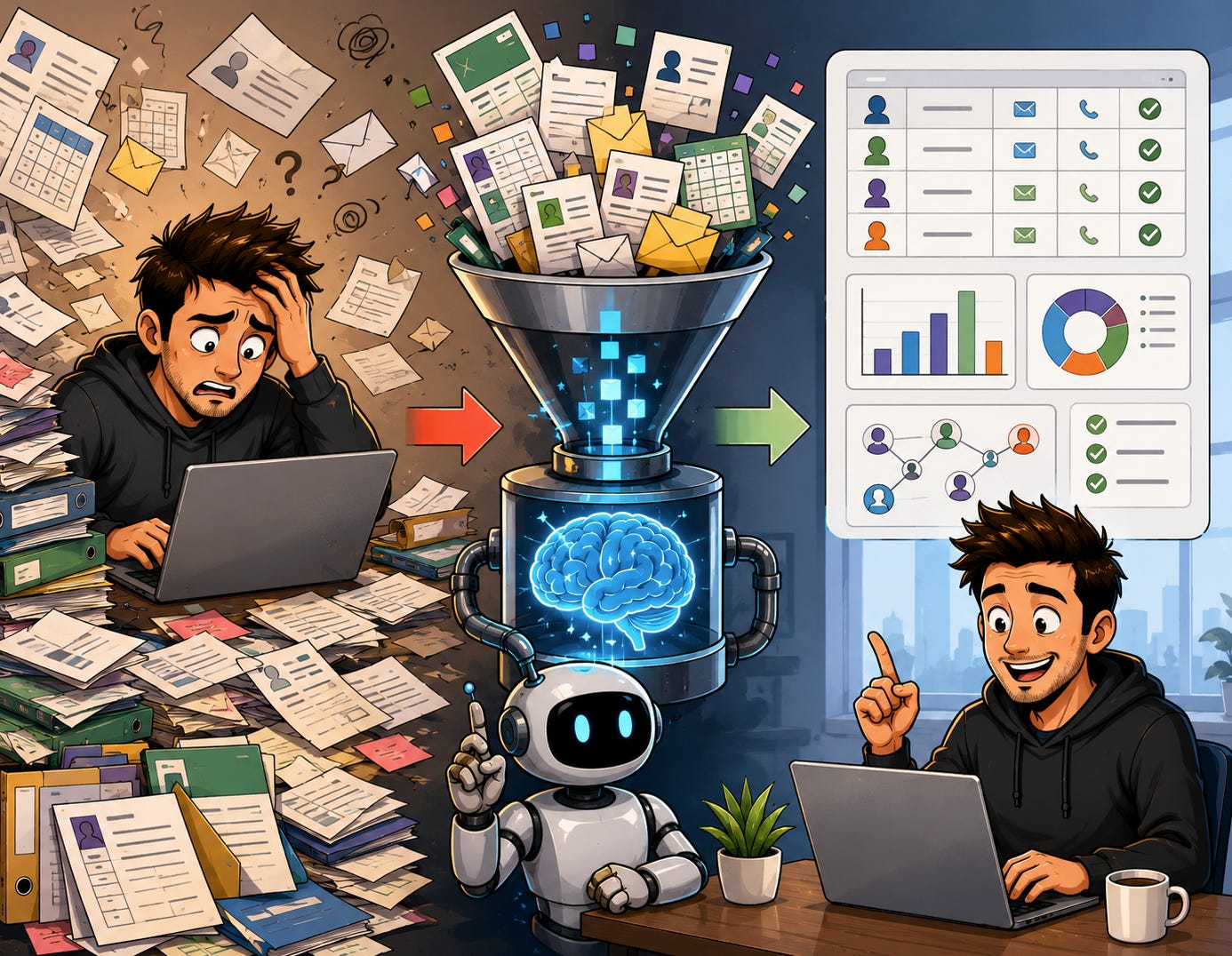
That’s the problem the Second Brain solves. It sits between your raw data and Claude, breaking large inputs into structured, queryable records in a database. Instead of one massive file that overwhelms the context window, Claude sees clean rows it can process, search, and cross-reference without hitting any limits.
Here are two real use cases from my own experience that show exactly how this works.
Use Case 1: Merging Contacts from Multiple Sources into One Clean Database
If you run more than one business, or even one business with more than one data source, you know this situation. Customers in one spreadsheet, leads in another, investors in a third, maybe a fourth export from some CRM or platform you used two years ago. Every file has different columns. Some split first name and last name. Some have a single “Name” field. One has phone numbers, another doesn’t. Formats are inconsistent. Duplicates are everywhere.
At some point you need a unified view. Who are these people? Where do they overlap? Who is a customer in one business and an investor in another?
This looks like a straightforward AI task. Upload the spreadsheets, ask Claude to merge them. Done.
Except it doesn’t work at scale. If your dataset is a few hundred rows, AI can handle the merge. But when you’re dealing with thousands of contacts across multiple exports, the model truncates data, hallucinates entries, or gives you a partial result and acts like it’s done. Large CSVs exceed what any chat-based AI can process in one shot.
How the Second Brain makes this work
The Second Brain treats contacts as a proper database, not a chat attachment. Each contact is a record in a SQLite table. Each field (name, email, phone, company, source, payment history) is a column. When you import from multiple spreadsheets, the data gets normalized into one unified schema.
Now Claude can do the job it couldn’t do before.
Query across sources: “Show me everyone who is both a paying customer and an investor.” That’s a SQL join. Claude runs it in seconds.
Deduplicate properly: Match on email, name + company, or phone number. You define the rules. The AI doesn’t guess.
Enrich on clean data: “Which contacts are missing an email address?” “Which customers from 2023 never logged in again?” These questions are easy when the data is structured. They’re impossible when you’re staring at five different Google Sheets.
Sometimes the source data is even messier than mismatched columns. I’ve dealt with CSV exports where everything was stuffed into raw JSON payloads. Name, phone, address, service history, review status, all buried inside a single field. The Second Brain extracts and normalizes this automatically. You go from unreadable blobs to clean, queryable records, and suddenly you can ask things like “show me all clients in a specific city who completed more than 3 jobs but never left a review” and get an answer in seconds.
The AI didn’t get smarter. The data got structured. That was the only difference.
Use Case 2: Proofreading a 200+ Page Book
I wrote a book called “Bones: 21 Clichés Running and Ruining Your Business.” After months of writing and rewriting, I needed a serious proofread. Not just grammar. English is not my native language, and when you produce 200+ pages, small issues compound. A slightly unnatural preposition, an odd word choice, a sentence structure that’s technically correct but sounds off to a native ear. Over that many pages, these pile up.
Proofreading a book. That’s exactly what AI should be able to do. Upload the document, ask Claude to review it. Simple.
If you haven’t tried this with a long document, let me save you the frustration. It does not work.
Why large documents break AI
Large language models have context windows. Even the biggest ones cannot hold a 200+ page document in working memory at once. Here’s what actually happens.
The model reads the first chunk and does solid work on it. By the page 20-30 of the book, it’s lost track of tone and style decisions from the first chapters. By the end, it’s proofreading in isolation, with no awareness of the whole.
The response hits its output limit long before the job is finished. You get corrections for the first 20 or 30 pages. Then it stops. You ask it to continue. Now it’s working from a fragmented context. Quality drops with each continuation.
Formatting gets in the way. Word documents carry metadata: styles, headers, footers, comments, tracked changes. The AI confuses structural elements with content. Edits break your formatting. Sections get skipped entirely.
The result: maybe 15% of your book gets reviewed, inconsistently, with no guarantee the same standards applied throughout.
How the Second Brain makes this work
Instead of feeding Claude one massive .docx file, I just imported the book into the knowledge base. Each page became one row in a database table.
Now Claude wasn’t processing a 200-page Word document. It was looking at a table with 200+ rows of clean text. No formatting noise. No embedded images. No metadata. Just the words.
The real power showed up in cross-document queries. “Find every instance where I used ‘which’ instead of ‘that’ in a restrictive clause.” “Flag pages where the tone shifts noticeably from the pages around them.” “List every sentence longer than 35 words.” These consistency checks only work when the full text is structured and queryable. They’re impossible with a monolithic file.
The proofreading quality stayed high from page 1 to page 211. The AI never had to manage a large document. It just did what it’s good at: analyze text, one piece at a time, with the ability to reference everything else when needed.
Why This Keeps Happening
These two use cases look completely different. One is data merging. The other is prose editing. But the failure mode was the same: the AI had the skills for the job, but the input was in a shape it could not work with.
AI models are excellent at analyzing, comparing, and transforming organized data. They struggle when the first task is organizational.
The Second Brain fills that gap with two layers: structure and Skills.
Structure is the road. Your raw data gets normalized into a queryable database so AI has something to work with.
Skills are the rules of that road. A Skill is a set of instructions attached to your Second Brain that tells Claude how to behave with your specific data. Which tables exist. How sources relate to each other. What to never guess about. What to ask before doing. It’s the rulebook for your knowledge base.
This is why “upload your file and ask AI” keeps disappointing people. No structure, no rules. You’re asking a powerful engine to drive without a road or a map. The Second Brain provides both.
Where This Is Going
We started building the Second Brain to solve our own problems at Hexact. Since then, we’ve been using it to store and query across all of our published articles, track customer and lead data in one place, and connect ideas across different knowledge domains.
It works with the tools we already have. Hexomatic collects and enriches the data. The Second Brain stores and structures it. Claude analyzes it on demand. The combination is more useful than any of those pieces alone.
We’re still early in development, but if you’re dealing with scattered data across multiple sources, documents too large for AI to handle, or knowledge that needs structure before it becomes useful, this is what we’re building toward.
Want to see how it works? Book a call with us and we’ll walk you through the current setup, from data import to your first cross-source query.
Already using Hexomatic for data collection? The Second Brain adds the storage and analysis layer that turns scraped data into a working knowledge base.