

Attention is the currency. Not because “content is king”, but because distribution wins. And distribution often comes down to one thing, finding the right profiles consistently.
Influencers, micro-creators, local pros, niche pages, small businesses, partner accounts, outreach lists, engagement targets. Every growth play turns into the same bottleneck:
Manual profile hunting is messy, slow, and easy to avoid. So most teams skip it.
Direct scraping of social platforms is also where things get annoying fast. Logins, rate limits, dynamic pages, bot defenses, broken HTML, constant changes.
There is a cleaner shortcut.
Google already indexed a huge chunk of public profiles and public posts. So instead of “scraping Instagram,” you scrape Google Search results that point to Instagram profiles (or TikTok, YouTube, X, LinkedIn, Facebook pages, etc.). You stay in the public web lane, and you still get scalable results.
Below is a step-by-step walkthrough using my real example.
The core idea
You are not scraping social platforms directly.
You are scraping Google results that reference social profiles.
This gives you:
More stability
You are using a managed Google Search automation inside Hexomatic. No custom scrapers to maintain, no constant fixes. We handle the infrastructure and changes.
No friction
No logins. No sessions. No cookies. No account bans. You work with publicly indexed pages only.
Faster iteration
You adjust search queries, not scraping logic. Want to refine targeting? Change keywords and rerun. No rebuilds.
Important note: this approach targets public pages and public profiles only.
Use case example: Urgify needs local service providers
Urgify connects customers with local service providers for urgent jobs. To fulfill demand, the first priority is supply, a large pool of local, independent providers.
Where are these providers discoverable?
Google Maps
Instagram (surprisingly good for local trades)
So I want two pipelines:
A Google Maps-based lead list
An Instagram-based lead list
Then I run both monthly to keep the pool fresh.
Step 1: Generate your keyword set
You need scale, so you need many search phrases.
For Google Maps, examples:
handyman miami
locksmith miami
electrician miami
plumber miami
garage door repair miami
appliance repair miami
tv mounting miami
junk removal miami
pressure washing miami
mobile mechanic miami
Now the “Google to Instagram” version adds a site/operator layer:
Examples:
site:instagram.com handyman miami
site:instagram.com locksmith miami
site:instagram.com “Miami” “handyman”
site:instagram.com (handyman OR contractor) miami
site:instagram.com “Miami” “licensed electrician”
You can ask ChatGPT to generate 100 to 200 variations, but keep them clean and realistic. Google rewards natural phrasing more than keyword soup.
Tip: Mix intent styles:
Service + city (“handyman miami”)
Service + neighborhood (“handyman brickell”)
Service + “near me” style phrasing (“mobile mechanic miami fl”)
Spanish variants if relevant in your market (“cerrajero miami”, “plomero miami”)
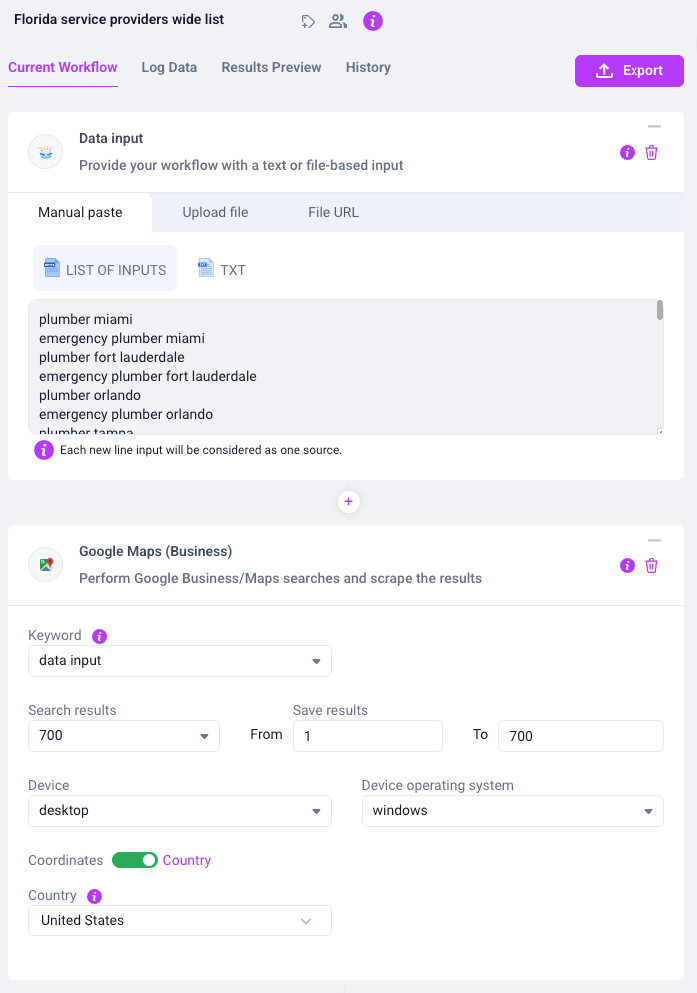
Step 2: Build Workflow #1, Google Maps discovery
This workflow is for “find businesses.” Later you can enrich.
Goal: collect business names, sites, address, phone numbers and basic metadata.
Workflow outline
Step 1: Data input: Paste your “service + location” keywords list
Step 2: Google Maps scraper
Step 3: Build Workflow #2, Instagram discovery via Google
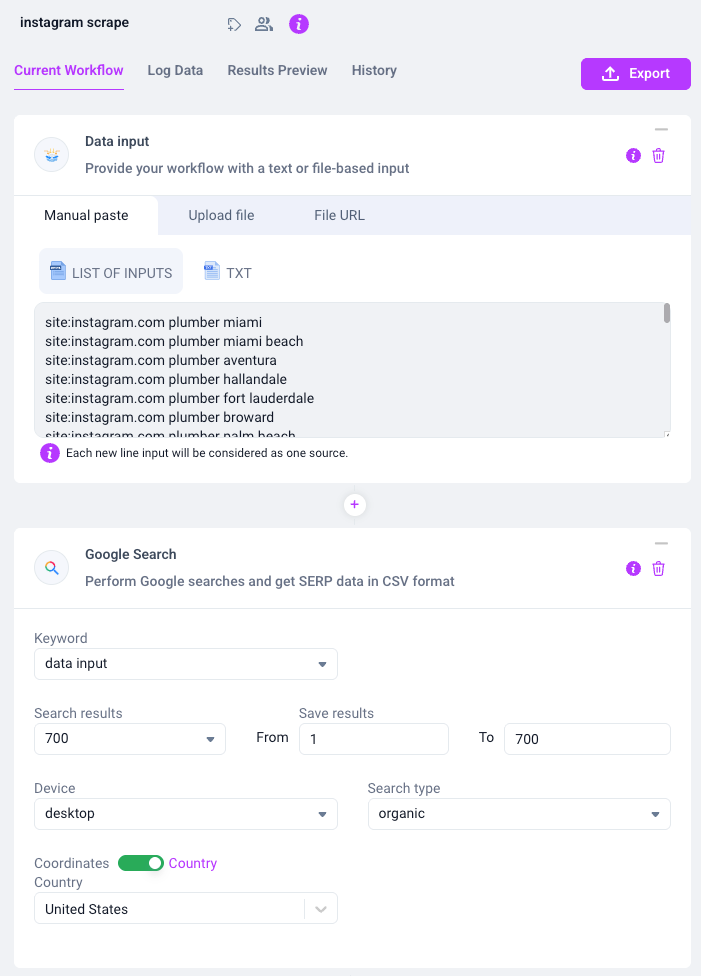
This is the money workflow for “social profiles at scale.”
Goal: collect business profile links on Instagram.
Workflow outline
Step 1: Data input: Paste your your Instagram-focused queries
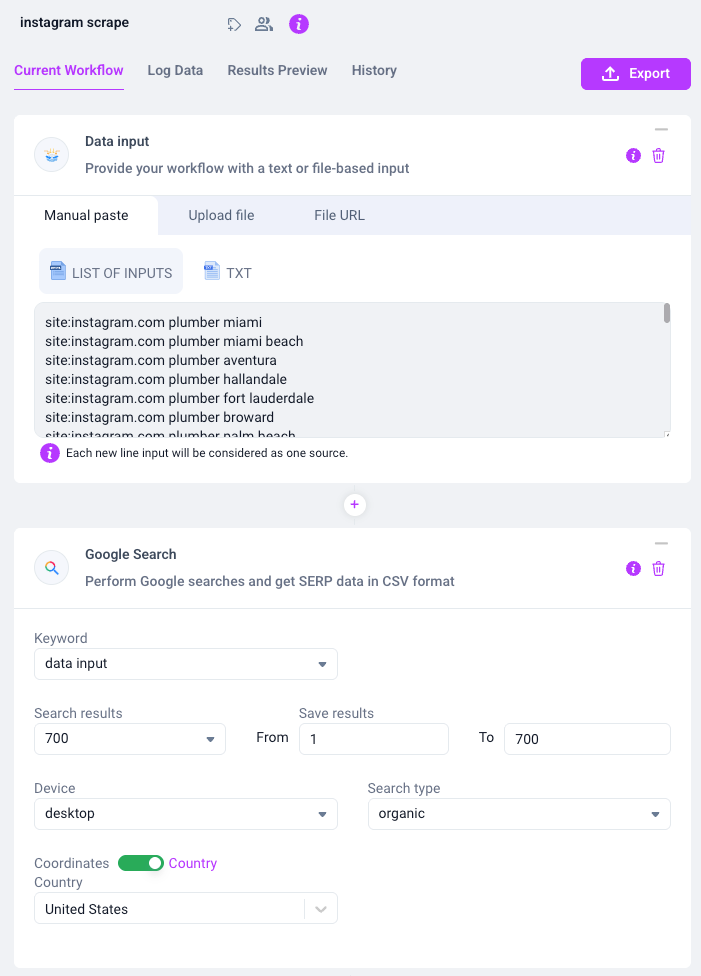
Step 2: Google Search scraper
Quick filtering trick
If you only want profile pages, focus on patterns:
Keep URLs that look like instagram.com/<username>/
Drop URLs that look like posts, reels, or tags:
/p/
/reel/
/tv/
/tags/
Depending on your exact queries, Google may return mixed results. That is normal.
Step 4: Export results, dedupe, and normalize
You will get duplicates because:
multiple keywords find the same profile
Google returns the same target across slightly different phrasing
Basic cleanup rules:
Normalize URLs (strip UTM params, strip trailing junk, force consistent trailing slash)
Dedupe by normalized URL
Keep the keyword that found it (useful for segmentation later)
If you are using both Maps and Instagram lists, keep them separate at first, then merge later if needed.
Step 5: Apply “small business” filters (this matters)
You said it perfectly, you want smaller providers, not big franchises.
For Google Maps leads
Filter out:
Franchises, chains, multi-location brands
Very large review counts
Keep:
Lower to mid review counts
Owner-operator style branding
Service-area style providers
For Instagram leads
Shortlist:
Smaller accounts (micro-providers)
Activity in the last 1 to 2 months (recent posts, reels, stories highlights)
Local indicators in bio (Miami, neighborhoods, phone, WhatsApp, service area)
In many niches, smaller accounts convert better. They answer DMs. They are hungry. They move faster.
Step 6: Turn it into a recurring monthly pipeline
The real win is not “I scraped a list once.”
The win is “I now have a machine that refreshes my pool every month.”
Do this:
Save both workflows
Run monthly
Append results to a master sheet
Only outreach newly discovered profiles (dedupe against the master)
You end up with a continuously updated candidate funnel.
Practical use cases beyond Urgify
Once you understand the pattern, you can repurpose it everywhere:
Influencer sourcing for local brands
Find micro-influencers in a city by niche, then outreach with a clear offer.
B2B lead lists from LinkedIn pages (public)
Scrape Google results that point to company pages, founders, or public profiles.
Competitor audience mining
Search for “reviews”, “unboxing”, “complaints”, “alternatives”, then find creators talking about the category.
Podcast guest discovery
Scrape Google for “podcast + niche + city” and extract host profiles.
Recruiting providers, affiliates, or resellers
Exactly like Urgify, but for any marketplace or partner program.
Common mistakes that kill results
Using queries that are too broad (“handyman florida”). You get noise.
Not keeping the keyword column. You lose segmentation.
Not normalizing URLs. Dedupe becomes fake-dedupe.
Treating this like a one-time task, instead of a monthly feed.
Trying to fully automate “quality judgment.” You still need a human filter layer for the final shortlist.
Automation gets you 80% of the way, fast. Judgment gets you the last 20%.
If you want us to do it for you
If your use case is specific or you want a fully turnkey setup, you can order Hexomatic Concierge Service.
Brief your goal, and we will build the workflow(s), deliver a ready-to-run setup, and you can run it monthly.